
The apparent division into two compliance camps of Remuneration Report disclosure of KMP remuneration stems from classification of some executive roles as KMP and others as not. We offer clarification of, and guidance on practical application of, this classification.
GRG Remuneration Insight 85
by James Bourchier & Nida Khoury
30 June 2016
Remuneration Report disclosure of remuneration for Key Management Personnel (KMP) seems to be divided into two main camps being:
- a) those observing high corporate governance standards (the majority), and
- b) those who have reverted to the bad old days of minimalist compliance driven disclosures.
Some of this division stems from classification of some executive roles as KMP and others as not. This Insight discusses the purpose of and requirements for classification of executive roles as KMP, while seeking to clarify this classification and give guidance on its practical application.
What is the Purpose of the Requirement for KMP Remuneration Disclosure?
Related party disclosures have long been required in relation to company accounts. Related parties are directors and their spouses as well as their parents and children. Related party disclosures have been regulated because “knowledge of an entity’s transactions, outstanding balances, including commitments, and relationships with related parties may affect assessments of its operations by users of financial statements, including assessments of the risks and opportunities facing the entity” (AASB124 paragraph 8).
KMP remuneration disclosures are an extension of related party disclosures. The KMP disclosure provisions extend both the persons classified as related parties and the types of transactions that need to be disclosed.
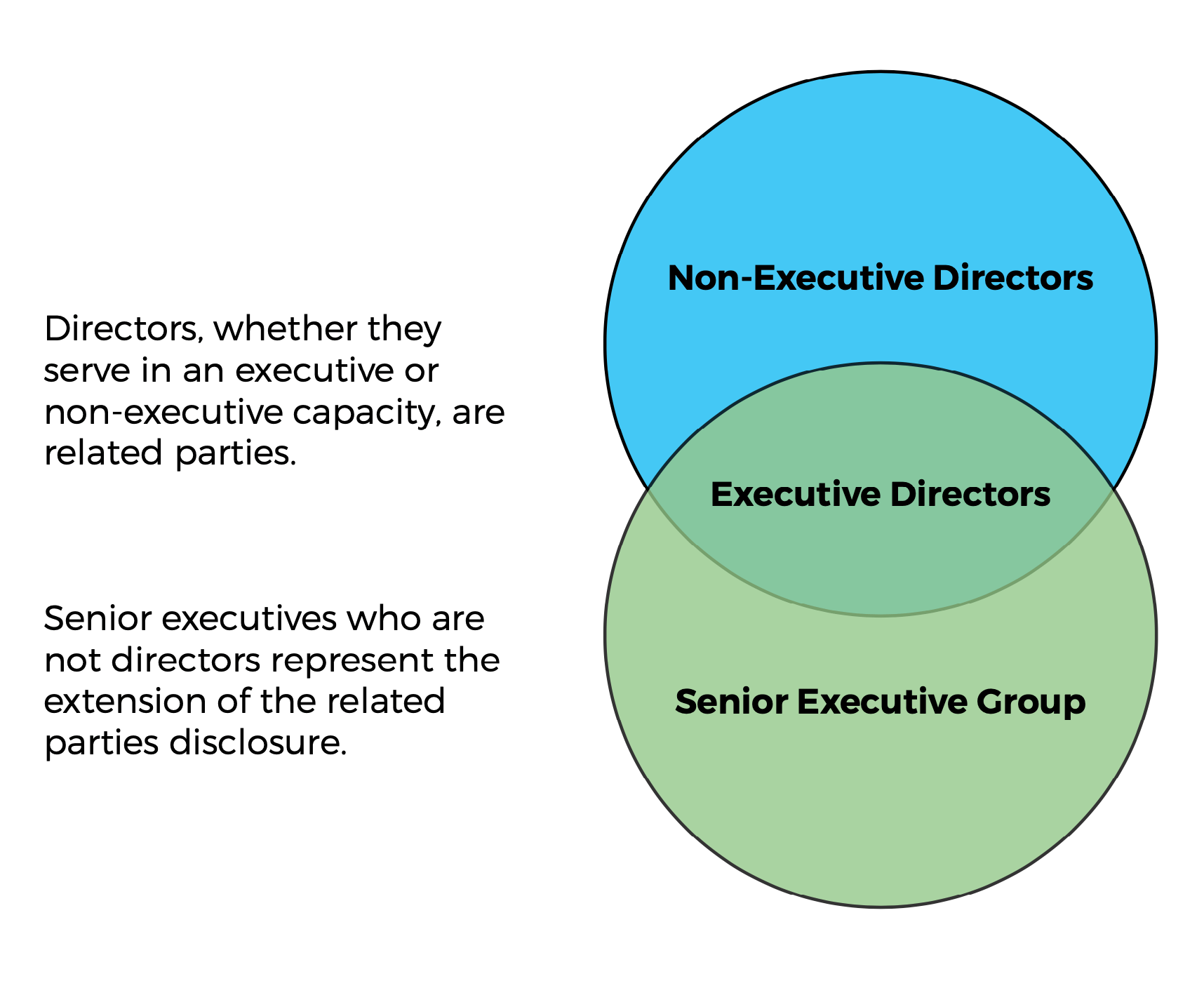
The definition of KMP (see later in this Insight) clearly encompasses directors. It is less clear in relation to senior executive roles. The executive roles are the ones where decisions on their inclusion as KMP should be considered in the light of both the purpose and wording of the definition. The remainder of this GRG Remuneration seeks to shed light on what executive roles should be regarded as KMP.
The broader definition of KMP, as opposed to related parties, recognises that investors and other stakeholders are interested in remuneration of all roles that are accountable to shareholders either directly (directors) or via the board (senior managers and direct reports to the CEO) for delivering, creating or protecting shareholder value.
Stakeholder Interests in KMP Remuneration
Aspects of executive remuneration that are of interest to stakeholders include whether:
- shareholders’ funds are being used responsibly, including:
- whether the quantum is reasonable,
- whether the elements that compose the remuneration are appropriate,
- whether the elements are in the right proportions,
- the right behaviours and performance outcomes that drive shareholder value creation are being motivated,
- performance related remuneration is:
- appropriate to the company’s circumstances and strategy, and
- demonstrably variable in relation to changes in performance, showing a transparent link between performance and reward.
It is clear that the intention of the requirement for KMP remuneration disclosure is not limited to particular roles or functions, but rather to provide information in relation to those individuals who represent the highest remuneration investment, have the power and authority to utilise shareholders’ resources (creating a potential conflict of interests) and whose responsibility it is to work together to create shareholder value.
The law does not take into account how organisations are actually designed and function, and instead looks to accounting standards, which has the benefit of being rigidly (bus insufficiently) defined – which is arguably necessary from a compliance perspective. Unfortunately this has led to a blurring of the intent of disclosure and the requirement for disclosure, which typically falls short of the needs of stakeholders in practice, when auditors and boards focus on compliance.
KMP Definition
Section 9 of the Corporations Act defines KMP as follows: ‘key management personnel’ for an entity has the same meaning as in the accounting standards.
Accounting Standard AASB 124 defines KMP as: those persons having authority and responsibility for planning, directing and controlling the activities of the entity, directly or indirectly, including any director (whether executive or otherwise) of that entity.
In relation to directors the fact that they are KMP seems to be well accepted irrespective of whether they operate in an executive or non-executive capacity.
In the 3rd edition of the ASX Corporate Governance Council’s guidelines titled Corporate Governance Principles and Recommendations (the Guidelines) the term senior executive is defined as follows for ASX listed companies that have boards elected by security holders in relation to remuneration matters: an executive who is a member of the key management personnel of the responsible entity, including an executive director but not including a non-executive director.
Previous editions of the guidelines included a broader definition as follows: the senior management team, as distinct from the board, being those who have the opportunity to materially influence the integrity, strategy and operation of the company and its financial performance.
Clearly, the change in definition was designed to align the Guidelines with the Corporations Act, presumably with the expectation that a material change in the roles covered should not occur. Given that the Corporations Act refers its definition to the Accounting Standards, which were not designed for this context, both now fall short of fulfilling the purpose of disclosure or the needs of stakeholders, if narrowly read.
Good Corporate Governance Application of Definition
Minimalist Compliance Application of Definition
GRG has observed that in a minority of cases a very narrow interpretation of the definition of KMP has been applied by some companies. Examples include the exclusion of Heads of Business Units that tend to operate in silos with little, if any, interaction with other business units. However, when these business units have significant scale and will impact the integrity, strategy and financial performance of the overall company it is difficult to see how the exclusion of such roles may be justified. Perhaps, if boards have adopted remuneration practices that would draw criticism from stakeholders then they may wish to exclude them to avoid criticism. Surely the purpose of requiring disclosure is to expose poor practices and to make boards more accountable. An old saying remains as relevant today as ever before: “sunlight is the best disinfectant”.
Best Practice
It is GRG’s view that disclosure of KMP remuneration should cover all senior executive roles that form the senior leadership team (SLT) and/or that are accountable for functions that may have significant influence on the company’s overall performance and financial results. The SLT, which is usually the CEO and his/her direct reports, represent a team of individuals at the highest level of organisational management who have the day-to-day responsibility of managing the company. They hold specific executive powers conferred on to them by the board to make decisions and put them into action for the benefit of shareholders. As such, the SLT is the decision making core of the company, effectively guiding the direction of a business. It carries significant responsibility, accountability and authority within an organisation.
The members of the SLT collectively create and implement the organisation’s vision/strategy, guide the direction of the business and evaluate its realisation. Hence, it is key to the success or failure of the business. The various line and functional SLT members are true business partners in this endeavour, and while one might debate the degree and nature of impact each SLT member may have on the overall business, they remain interdependent irrespective of the varying degrees to which an individual SLT’s role may have an impact on the business and whether the nature of this impact is direct or indirect.
In view of the above, an expansive rather than excluding/restrictive approach should be applied when deciding which roles should be reported. In this regard it needs to be noted that the Guidelines recognise that remuneration of senior executives is a key focus of investors. Thus, to avoid failure to meet investor needs it is important that an expansive approach be applied.
While an expansive approach may involve additional work, this work will be insignificant compared to the work involved in preparing a high quality Remuneration Report which should be the goal of all boards that are seeking to embrace good corporate governance that meets shareholder needs and expectations.
The following roles are roles that should normally be considered as KMP; especially if they are on the SLT, or may have a material impact on the organisation’s results, if not on the SLT:
- Chief Financial Officer
- Chief Operations Officer (COO)/Head of Operations
- Business Unit Head
- Regional Manager
- Country Manager
- Head of Sales
- Head of Marketing
- Head of Sales and Marketing
- Head of Business Development
- Head of Strategy
- Head of Logistics/Supply Chain
- Head of Risk
- Head of Human Resources
- Head of Corporate/Shared Services
- Chief Investment Officer
- Chief Technology Officer/Chief Information Officer
- Legal Counsel
- Company Secretary
- Legal Counsel & Company Secretary
- Chief Medical Officer
- Head of Research and Development
- Project Manager
- Head of Production
- Mine Manager
- Exploration Manager
These are typical roles that may be observed to be regularly classified as KMP, however there are of course other roles as well.
The circumstances of a company, its organisational structure and the designs of individual executive roles need to be considered when determining which of the foregoing roles should be reported as KMP by individual companies. However, if doubt remains as to whether a role should be classified as KMP then GRG’s view is that it should be included in the interests of good corporate governance and transparency, and to eliminate the risk of criticism.
GRG may appear to have a vested interest in this transparency, however it is one which is shared by analysts, journalists, other remuneration consultants, data providers, proxy advisors, and arguably boards. Without extensive disclosure on these issues the ability of those outside the organisation to comment on remuneration and gauge its impact on company performance and the interests of shareholders is limited. This is a community issue, and one that ought not to be dominated by auditors urging the adoption of compliance-based approaches for reasons that should not be of concern to boards that have no cause for fear of sunlight. Part of the inspiration for writing this article is the constant observance that clients seek to benchmark more roles than they disclose, and are often frustrated that there are not better disclosures in the market to benchmark against.